
Pattern and Flow
Works
- 2022
- Books / editorial
- The Metropolitan Museum of Art
- Pattern and Flow
A comprehensive study of the American revival of decorated paper (marbled paper, paste paper, fold-and-dye papers, etc.), in the 1960s and its subsequent development through the end of the century.
The history of decorated paper mirrors that of publishing itself. For almost as long as humans have made books, they have used painted, marbled, and stenciled papers as materials to create covers and endsheets. The precision of the result—the density of color and fine linework in a marbled sheet, for example—might lead you to believe that these papers were mass produced, but in fact even in large editions each sheet was unique, the work of an artisan working one sheet at a time. These people worked for hire and rarely rated a mention in a book’s colophon.
As commercial printing became more mechanized and sophisticated, the use of these papers fell off. A publisher could actually print a cover and—if they chose even to use them—endsheet material and each would be as identical as mechanical processes would allow. Binders still occasionally used decorated papers, but typically in so-called fine press editions. The techniques of creating these unique papers faded from public knowledge.
In the 1960s, fueled simultaneously by psychedelic culture and a popular interest in handicrafts, American artists began making decorated papers again. There were no masters, and no roadmap save an article in a 1962 edition of American Artist magazine, a terse set of instructions in Pauline Johnson’s Creative Bookbinding, and a rare 19th century German manual, distributed hand-to-hand as electrostatic copies. Some artists dug deep into the history of the form, reviving and preserving traditional patterns. Others used these traditions as grist and over the last forty years of the century created an entirely new vocabulary.
What they held in common with their predecessors was anonymity. The book arts is an (unfairly) obscure neighborhood of American art history, and papermakers can easily be overlooked even within it. In 2017, Mindell Dubansky, an experienced bookbinder and Conservation Librarian at the Watson Library of the Metropolitan Museum of Art in New York, realized that the generation of papermakers that revived the craft in the United States was not getting any younger. She set about collecting papers, documentation, tools, business records, correspondence, and more from each of them, creating the Paper Legacy Project at the Watson, a collection now numbering several thousand assets.
In 2019, via a referral from our friend Roberta Lavadour, Ms. Dubansky contacted us for help assembling some of this material into the first monograph on the subject. Three years later, here is the result.
Illustrations
1
Front cover

The book is quarter-bound in cloth with a rounded back. A facsimile of a Chevron Gel-Git pattern made in 2017 by Regina St. John is shown full-size. The title is composed in one of Louis John Pouchée’s elaborately decorated alphabets, designed by Pouchée in 1820 for sale to poster-printers. These letters, though antedating the book’s subject by over a century, share a sensibility with the work featured therein: utilitarian objects made extraordinary through exuberant craft.
2
Main title
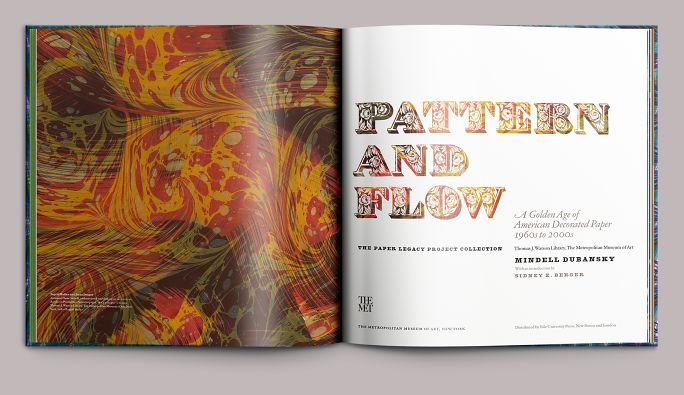
At left, a full-size detail of Ingrid Butler and Dana Draper’s underpainted marbled paper Autumnal Flame, extended into the main title.
3
Section divider
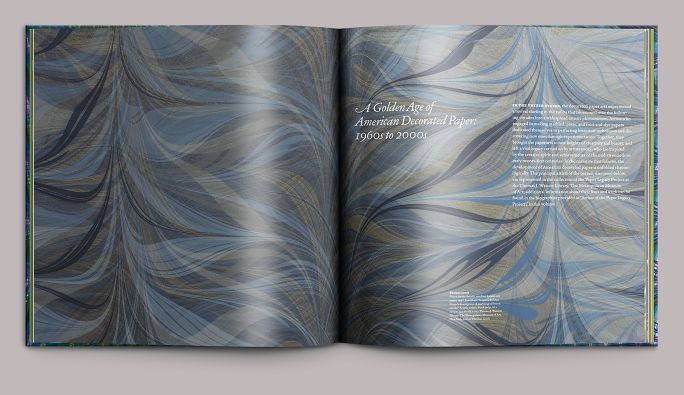
Introduction to the main narrative, showing a full-size detail of Frozen Smoke, a 1997 marbled paper by Thomas Leech. In general, the papers in the collection run between 16 × 20 and 24 × 36 inches, so there was never the possibility of showing a full sheet. It’s important to see the designs at full scale, though, so the book is packed with details like this one; full sheets are shown at ⅓ actual scale.
4
Chapter opening

Let’s look at a few pages from the 1960s section. Here’s the opening, featuring a detail of an early experiment by Paul Maurer. The narrative runs to the left side of a given page, with the right two columns given to smaller reproductions and ephemera: in this case, Samuel Webb’s 1962 article in American Artist that served as a primary text for many of Pattern and Flow’s artists.
5
Chapter interior

There was a lot of ancillary material: books, magazines, tools, letters, etc. In keeping with our philosophy of direct labeling (about which see practically any other book on this site), we worked hard to show illustrations as close to their textual references as possible, an enterprise that benefited by having a sympathetic editor in Livia Tenzer.
6
Chapter, continued

As mentioned above, full sheets are shown at ⅓ actual size. The squarish nature of the book derives expressly from this decision: papers could be portrait or landscape in orientation, according to their makers’ wishes. The book accommodated both easily, without the need for crossovers (except in the case of Jake Benson’s massive Old Dutch sheet). At left is an overmarbled paper for which artist Paul Maurer used Tabasco sauce as a dispersant.
7
Chapter, continued
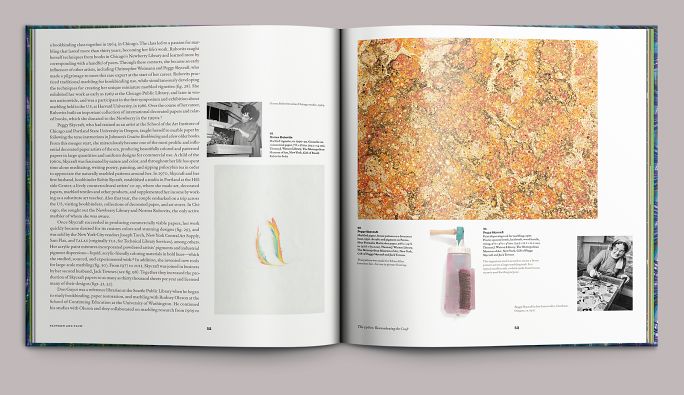
Each artist is shown in a small squarecut portrait (ideally but not always contemporaneous with the section in which they appear) rendered in black and white, to separate them from the brightly colored work. At left is a marbled vignette by Norma Rubovits; at right is a marbled sheet (Stone pattern on Stormont base) by Peggy Skycraft, shown over the dispersing tool she invented to make it.
8
Chapter, continued
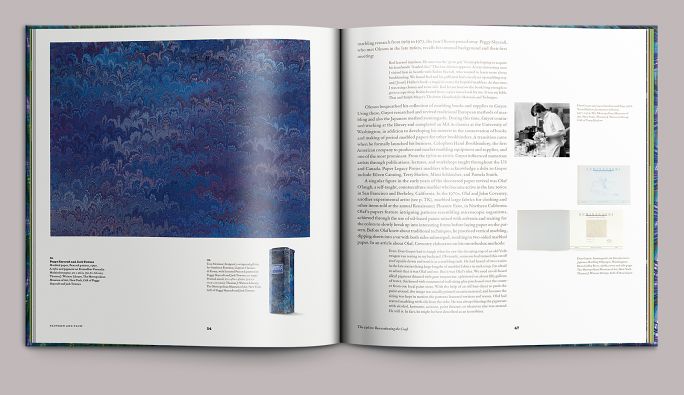
At left, Peggy Skycraft and Jack Townes’ blue Peacock pattern marbled paper, used extensively in packaging for Sambuca Romana.
9
Chapter, continued

The end of the 1960s chapter, showing an elegant marbled paper in a Wave pattern by the late Don Guyot; at right, two experimental papers (from left, Purple Monchromatical Monomaniacal Merry-Go-Round and Inelegant Reject #1221) from Bay-area iconoclast Olaf, who, though he never sold his work, has been an important vector for the sharing of knowledge.
9
Chapter divider

Chapter divider showing detail of a marbled paper with collage made by John Coventry in the early 1970s.
10
Biographies, opening

Pattern and Flow ends with detailed, illustrated, and cross-referenced biographical sketches on each artist included in the Paper Legacy Project.
11
Biographies, continued

12
Biographies, continued

Colophon
188pp + cover
10½ × 11 in., ed. 3,000
Text: 6c offset on coated matt paper
Cover: 4c offset + matt laminate; half-bound in cloth with rounded back; metallic foil
Composed in ATF Garamond and Antique No. 6; display letters are Louis John Pouchée’s 18 Lines No. 1, used courtesy of Ian Mortimer and St Bride Library
- Author
- Mindell Dubansky
- Editor
- Livia Tenzer
- Introduction
- Sidney E. Berger
- Foreword
- Kenneth Soehner
- Separations and color
- Peter Jennings
- Photography
- Peter Jennings
- Watson Library
- Publisher
- Thomas J. Watson Library, the Metropolitan Museum of Art, New York
- Printing
- Print Vision