Symmetry Breaking
Works
- 2017
- Books / editorial
- Art Gym
- Symmetry Breaking
The artists collected in this 2017 exhibition, curated by Blake Shell for the Art Gym, share a common interest in using traditional craft techniques—textiles, jewelry, beadwork, ceramics—in a manner well outside traditional applications. The show’s title is a term borrowed from physics that describes how a system can be changed by apparently insignificant shifts in energy in a way that encourages the development of pattern.
The book’s program is derived from a double square, a proportion that is symmetrical in two directions: vertically and—when the book is opened—laterally. Text and images undulate around a horizontal axis, moving in and out of symmetry as the book progresses.
Illustrations
1.
Front cover
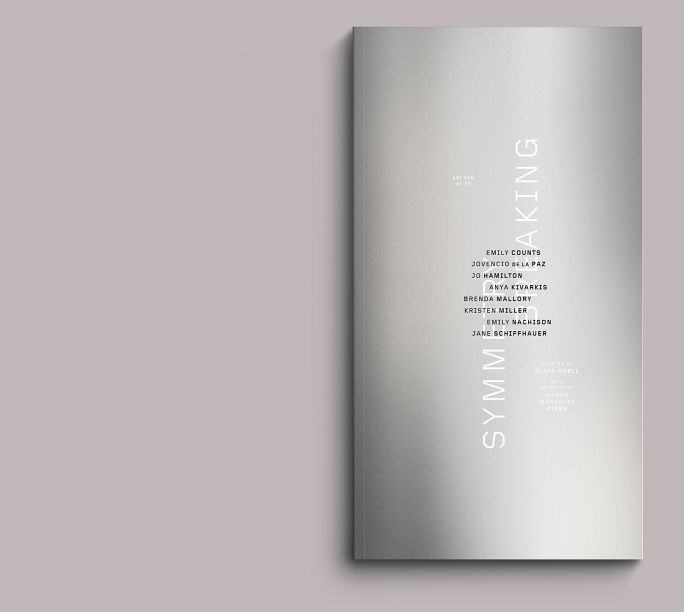
The cover is printed in metallic silver and black on uncoated, vellum-surfaced paper. It is an optical double square—meaning it’s not actually a double square, but a rectangle with its proportions tweaked to feel like one. The typographic scheme contains multiple axes: the title rotates around the horizontal axis; the artist’s names around the vertical, with a corollary: rather than a simple centering, the names align on the first common letter of each, working from top to bottom: e, then j, then a, and so on. This conceit follows through the book. It is symmetrical, but the symmetry is broken. (Please clap.)
2.
Introduction
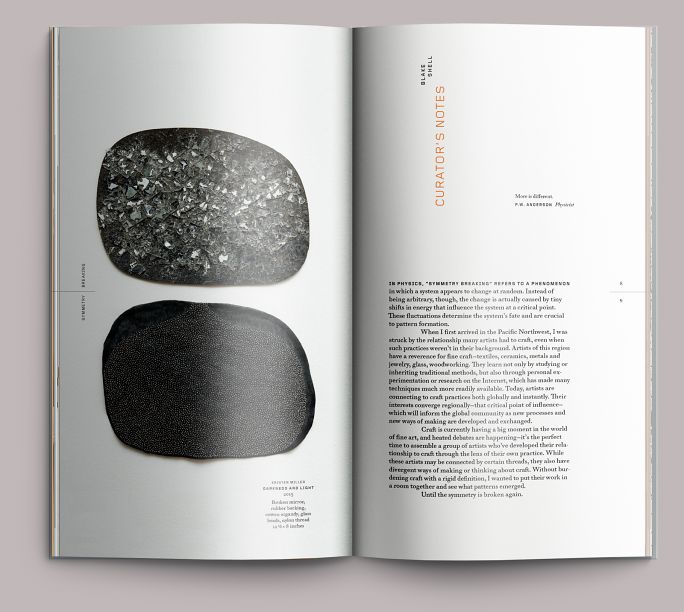
One of the reasons we were able to get away with such a narrow proportion is that the reproductions allowed it. Most of the work in the show was either vertical or squarish in proportion—the wider format pieces could be handled with a crossover. Folios are set to the outside edges of the page, and in some cases will overprint reproductions (see figure 4). As a rule, we won’t do that, but in this case it activated the page in an interesting way, almost as if it were a frame looking down into the artwork.
3.
Essay opening
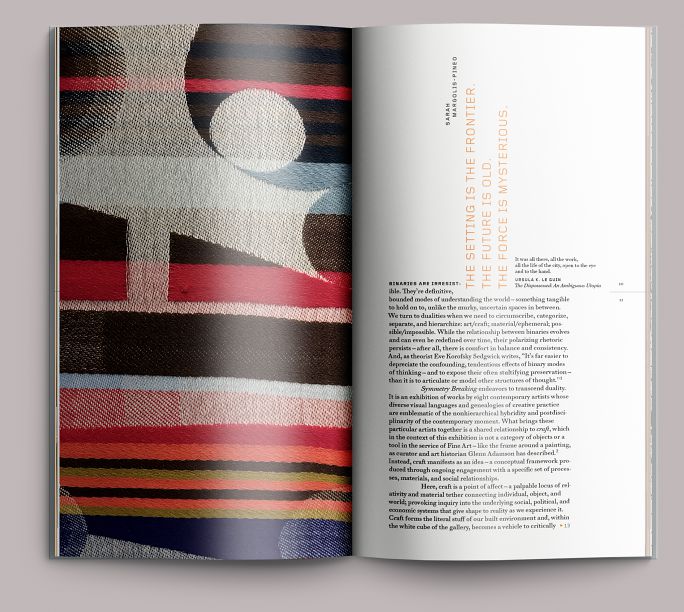
The book is composed principally in Fra tisek Storm’s Walbaum Text, in one column weighted toward the gutter: a traditional arrangement. The page’s horizontal axis forms the origin for text elements: the essay hangs from it, and other items—display type, epigraphs—rest on it. The essay is illustrated in context, each cited work shown as close as possible to its citation.
4.
Essay interior
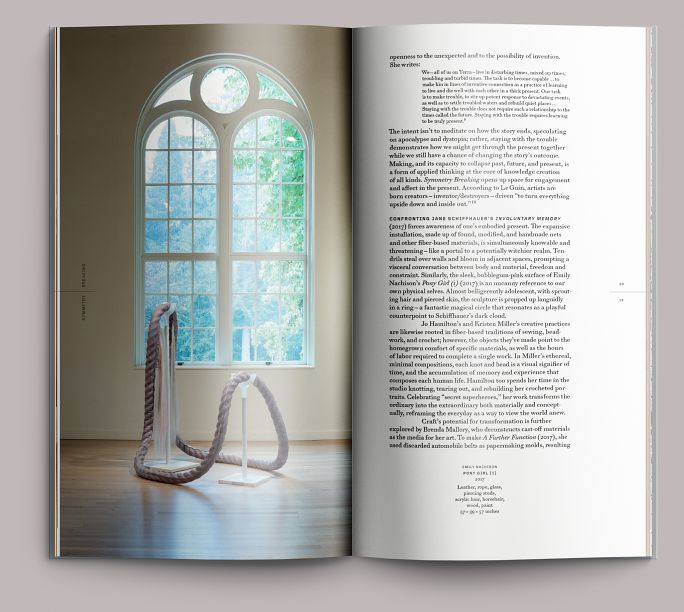
Inside, the text block runs the length of the page. Captions are independent of the page’s x and y axes; they are symmetrical within themselves, and can appear anywhere on the page. Here, the caption is placed in a position of glide reflection symmetry in relation to the Art Gym window.
5.
Artist opening
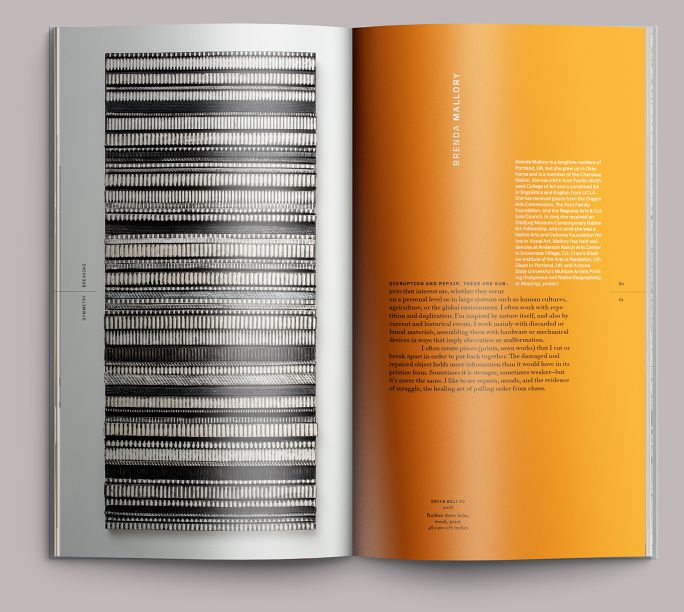
Each artist is allotted eight pages of the book, which includes a personal statement and a biographical sketch (an arrangement similar to the catalog for Art Gym’s previous large survey).
6.
Artist interior
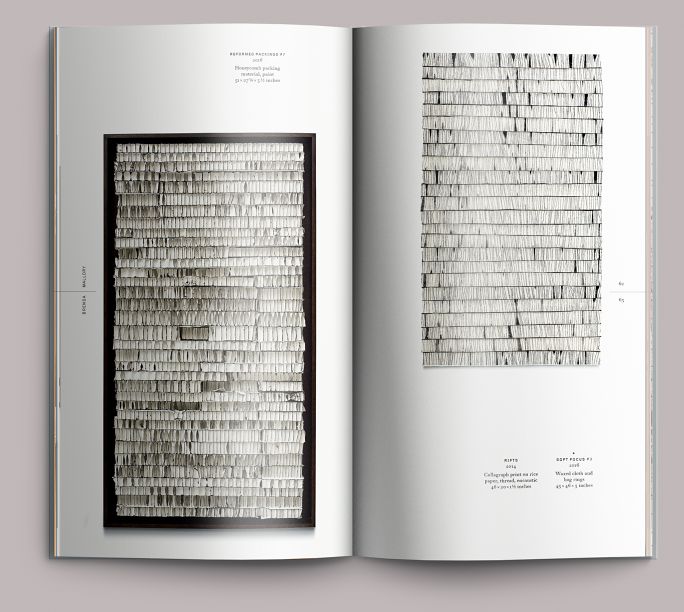
Within each allotment and when practical, the artist’s works are shown in relative scale.
7.
Artist interior
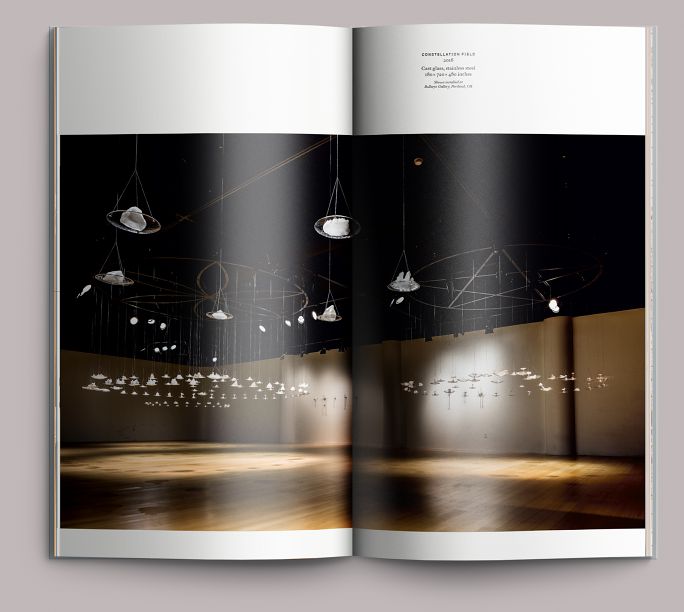
Derek Birdsall called white space “the lungs of the layout”; we once had a corporate client refer to it as “non-value-added space,” which we’re noting here just for posterity. This spread and the following give a good example of how important white space can be for pacing. Here, the white above and below frames the image, but also compresses it: the white both establishes a base for the values in the image (the shadows are richer for the contrast) and keeps the eye looking at the installation as a whole.
8.
Artist interior, detail
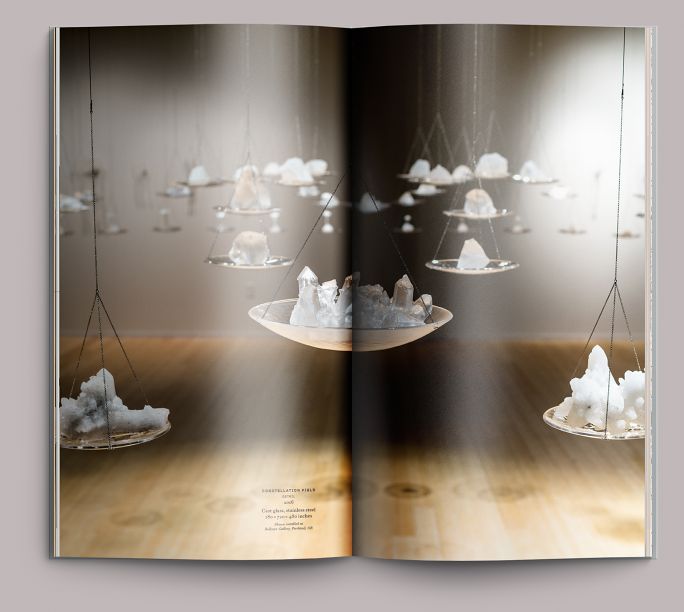
Here is a detail of the same work, presented as a full-bleed spread. The eye is free to roam where it will, but the transition between the two spreads gives the reader a sense of moving into the work.
Colophon
96pp + cover
6 × 11 in., ed. 300
Text: 4c digital on coated matt paper
Cover: 2c offset on uncoated paper
Composed in Walbaum Text and Foundry Gridnik
- Essay
- Sarah Margolis Pineo
- Editor
- Allison Dubinsky
- Photography
- Kathleen Murney
Bill Bachuber
Mike Bray
Calvin Ross Carl
Emily Counts
Jovencio de la Paz
Mario Gallucci
Dan Kvitka
Evan LaLonde
Erik Krough Nelson
John Sterling Ruth - Printing
- Brown Printing